New Orchid Growers - Your First Orchid
A Guide for Beginners

by Stephen R. Batchelor, courtesy of the American Orchid Society. These articles were published in the AOS Bulletin in the 1980's and ultimately were compiled into the excellent book Your First Orchid: A Guide for Beginners offered by the AOS.
General Orchid Information

1 - The Proper Approach
I must confess that I underwent a crisis of confidence when the Editor asked me to write a series of cultural articles for the beginner. Had that much time really passed since that day I enthusiastically purchased my first orchid, a cattleya orchid... read entire article
2 - Growing Outdoors and in Windows
With some ingenuity and persistence, conditions conducive to the growing and flowering of orchids can be achieved anywhere - from below ground level to the tops of tall buildings, inside under entirely artificial light, or outdoors in a more natural setting... read entire article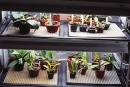
3 - Growing Under Lights
It is hard to imagine sun-loving plants like orchids flowering under the relatively low light intensities of conventional fluorescent tubes. But flower they do. What fluorescent lights lack in intensity, they can compensate for in daily light duration and in numbers... read entire article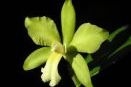
11 - Nomenclature
Beginning and inveterate orchid growers alike are constantly being offered either seedlings or mericlones as possible additions to their collections. Both are available either in flasks, community pots, or individually in two to... read entire article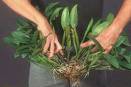
12 - Propagation on a Small Scale
Sooner or later, every hobby grower reaches that point where they ask the question "How can I propagate my plant"; or some variation of it like "Can I make more plants from cuttings?" Orchid hobbyists have several simple... read entire articleOrchid Growing Essentials
4 - Light and Temperature
Best flowering generally occurs under higher light intensities of longer duration that leads to the accumulation of food reserves needed for flowering. Cooler temperatures at night, when respiration continues while photosynthesis... read entire article
5 - Air Pollution, Movement and Humidity
Potted orchid roots require oxygen derived from the air pockets or well-aerated water present in a porous medium, because the uptake of water and nutrients (in addition to root maintenance and growth) is a process which demands energy... read entire article
6 - Water
Most orchids, particularly the epiphytes, have evolved to withstand dry conditions to some extent. Unlike other more tender plants, orchids don't usually cry out that they need water by wilting in a dramatic fashion. Instead a prolonged period of... read entire article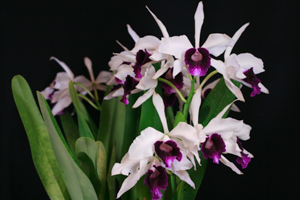
7 - Nutrition
Essential elements for plants are usually divided into two groups. Those needed in relatively large quantities are called the macronutrients (nitrogen, sulfur, phosphorus, potassium, calcium and magnesium) and those elements... read entire article
8 - Fertilizer
Soluble salts are at once a bane and a blessing in orchid culture. They can be present in dangerously high concentrations in water supplies and potting media, and yet they are what constitute conventional fertilizers, forming a salt when the water... read entire article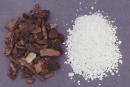
9 - Growing Media
Healthy roots are essential to orchids. Without a substrate conducive to root establishment, growth and function, an orchid cannot absorb the nutrients and water it requires. A growing medium should be firm and yet well aerated... read entire article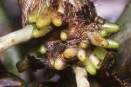
10 - Repotting
Organic media decompose into humus, a material, by itself, unfit for orchid roots. In a decomposed medium roots rarely have adequate oxygen to survive and function. Repotting must occur before significant media decomposition takes... read entire articleOrchid Pests and Diseases
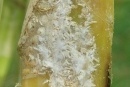
13 - Scale, Mealybugs and Aphids
Scale and Mealybug, who among us can say that they have never had an infestation of mealybug or scale in their orchid collection? Very few, I suspect! Surely among the most common of orchid pests, these closely-related creatures cause... read entire article
14 - Mites, Slugs and Other Nuisances
Far smaller than scale, mealybug or aphids, and requiring a hand lens (10x-20x) to be directly seen at all, spider mites and false spider mites treat orchid leaves like pin-cushions, and in large numbers can cause considerable injury... read entire article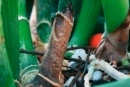
15 - The Ruinous Rots
Nearly every orchid grower has had some experience with black rots, whether they readily admit it or not! Because these rots are so lethal to plant tissue, and spread so quickly, I would venture to guess that more orchids have been lost to... read entire article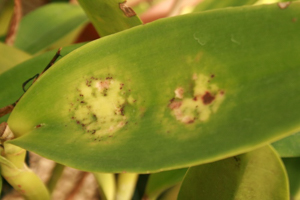
16 - The Flagrant Fungi
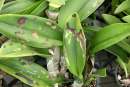
The typical orchid leaf, at some point in its lifetime, becomes spotted or damaged in some way, usually a result of infection by one of the many pathogenic fungi in the conventional growing environment. While rarely lethal except to the... read entire article