Orchid Culture - 2025 Questions & Answers

by Sue Bottom, from the St. Augustine Orchid Society Newsletter. Email us with any orchid question, if we can't answer it we'll find someone who can! Send photographs too!
)
Black But Hard Cattleya Pseudobulb
Q. I just noticed this black at the base of my cattleya. The pseudobulb is hard, not rotten. I guess it’s best to chop it off so it doesn't spread?A. That looks an awful lot like the fast moving black rot coming up from the roots into the pseudobulb and next through the rhizome into the other pseudobulbs. Cut, sterilize and keep cutting until you don't see any more discoloration in the rhizome. You can treat with something like Banrot, Subdue or Aliette if you have them, and then keep it on the dry side for a couple days. (Dec-25)
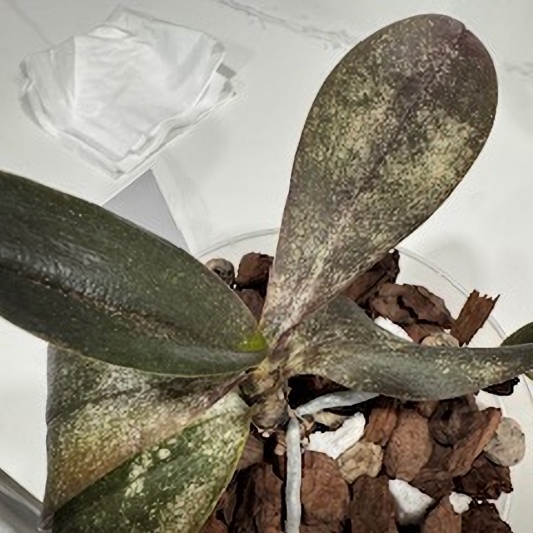
Mites on Phal
Q. I’ve been dealing with I think spider mites for the past year or so. I don’t see anything and there’s no webbing but I will see something that looks like rust if I wipe under the leaves. This is only on my phalaenopsis growing in the house under lights. I would appreciate any help you can give me.A. That sure looks like mite damage, they thrive in the dry environment under lights. You don't always see webbing, but the stippling on the upper leaf surface and the poop you see when you wipe the leaves are indicative of mites. If you get a loupe or a magnifier, you should be able to see them crawling around on the leaf underside. I use Avid for mites, you can get a generic abamectin that is a little cheaper. You'll spray thoroughly the upper and lower leaf surfaces at weekly intervals for a month. While you are waiting for the chemical to arrive, you can take the phal to the kitchen sink and wash it using dish detergent rubbing the leaves top and bottom. Then start your spraying program. You might also consider spraying everything that's under lights cause the mites will travel from plant to plant. (Dec-25)
)
)
)
Black Sunken Spots on Schombocatt
Q. This plant is important to me. I left for three weeks and when I came back, many of the leaves had these spots, which go right through the leaf. What shall I do?A. That looks like a schombocatt and they're pretty tough customers, but you don't know how fast the damage occurred or whether it was concurrent with excess leaf wetness. I'm debating whether it's a bacterial problem, which is what the damage on the leaf tips looks like, or anthracnose, which is what the damage close to the leaf axil looks like. I think I would cut away the severely damaged leaves and spray the plant with copper and see if that doesn't stop any further damage. Mary cut off lots of leaf tips but decided to leave some of the leaves with minimal damage, and sprayed with a copper fungicide/bactericide. (Dec-25)
Black But Hard Cattleya Pseudobulb
Q. I just noticed this black at the base of my cattleya. The pseudobulb is hard, not rotten. I guess it’s best to chop it off so it doesn't spread?A. That looks an awful lot like the fast moving black rot coming up from the roots into the pseudobulb and next through the rhizome into the other pseudobulbs. Cut, sterilize and keep cutting until you don't see any more discoloration in the rhizome. You can treat with something like Banrot, Subdue or Aliette if you have them, and then keep on the dry side for a couple days. (Dec-25)
Mites on Phal
Q. I’ve been dealing with I think spider mites for the past year or so. I don’t see anything and there’s no webbing but I will see something that looks like rust if I wipe under the leaves. This is basically only on my phalenopsis and they are in the house under grow lights. I would appreciate any help you can give me.A. That sure looks like mite damage, they thrive in the dry environment under lights. You don't always see webbing, but the stippling on the upper leaf surface and the poop you see when you wipe the leaves are indicative of mites. If you get a loupe or a magnifier, you should be able to see them crawling around on the leaf underside. I use Avid for mites, you can get a generic abamectin that is a little cheaper. You'll spray thoroughly the upper and lower leaf surfaces at weekly intervals for a month. While you are waiting for the chemical to arrive, you can take the phal to the kitchen sink and wash it using dish detergent rubbing the leaves top and bottom. Then start your spraying program. You might also consider spraying everything that's under lights cause the mites will travel from plant to plant. (Dec-25)
Black Sunken Spots on Schombocatt
Q. This plant is important to me. I left for three weeks and when I came back, many of the leaves had these spots, which go right through the leaf. What shall I do?A. That looks like a schombocatt and they're pretty tough customers, but you don't know how fast the damage occurred or whether it was concurrent with excess leaf wetness. I'm debating whether it's a bacterial problem, which is what the damage on the leaf tips looks like, or anthracnose, which is what the damage close to the leaf axil looks like. I think I would cut away the severely damaged leaves and spray the plant with copper and see if that doesn't stop any further damage. Mary cut off lots of leaf tips but decided to leave some of the leaves with minimal damage, and sprayed with a copper fungicide/bactericide. (Dec-25)
)
Little White Balls in Media
Q. I just found this in two areas in a small 5" pot of Orchiata. It doesn't look quite like the snow mold I've had before,more like tiny eggs or is it snow mold?A. I don't think that's snow mold, maybe spider eggs or some other kind of eggs. I'd repot it just the same as if it were snow mold so you don't have a population explosion on your hands! (Nov-25)
)
Brown Markings on Maudiae Paphs
Q. My Maudiae-type Paphs get these brown markings that cripples the leaves and the flower stem while it is developing. Please help.A. If I had to guess, I'd guess Erwinia, a bacterial infection. You might think of applying some copper sprays to your paphs. (Nov-25)
)
)
Little Tan Balls at Base of Plant
Q. What are these little balls that are all over the base and roots of my vanda. I have two plants that have been affected. Leaves rotting and falling off at the base recently. All orchids are routinely treated for fungus.A. That vanda looks like it is infected with Southern Blight, a disease caused by Sclerotium rolfsii. The main symptom of Southern blight is a rapid collapse and rotting of the roots, stems and lower parts of the leaves. The disease eventually girdles and destroys the entire basal portion of the plant. Affected leaves yellow, wilt and die. The small yellow or tan sclerotia resemble mustard seeds on the affected tissue. This is the resting form of the fungus. Unless the plant is very valuable to you, discard it and disinfect the surrounding area with bleach. Some of the expensive Frac 7/11 fungicides are reported to be fairly effective, but this plant is probably beyond saving. (Nov-25)
)
)
Problem Spreading to Phalaenopsis
Q. I’ve isolated this phal and treated it with 3-1 Bayer and then later with Physan 20. but it’s already spread to four other phalaenopsis. I don’t know what it is. Nothing rubs off. The underside seems clean. Do you have any ideas?A. That looks like mite damage on the top surface, but the bottom looks clean, so I'm thinking it's not the red spider mites but some of those much smaller mites. If you have a loupe or good magnifier, look for anything crawling. I would be thinking of spraying a miticide on all your phals, pronto, something with abamectin in it like Avid. If you don't have any miticide in your aresenal, get out the isopropyl alcohol and add some vegetable oil and dishwashing soap to it and spray all the surfaces. Then, order some Avid to keep on hand for mites. (Oct-25)
)
New Growth Rotting at the Tip
Q. What causes a new growth that starts off healthy to start browning at the tip, and then it gets stunted and eventually starts to slowly rot. I have seen that the most among orchids from the Stanhopea alliance. The growth on this Acineta started off great, a hard bulb with no sign of rot at the base. Now it has stopped growing and the tip is getting darker so I am sure it will wither away slowly.A. I haven't had that problem with Stanhopeas so I'm just guessing, but it looks like rot is setting in. Here's a trick from Keith Davis. Have you seen those little plastic cups like apple sauce comes in? You might try placing one of them over the new growth to prevent water from accumulating until it grows up a bit and hardens off, to see if that protects the tender new growth from rot. (Oct-25)
)
Dendrobium Keikis
Q. Many of my dendrobiums did not get enough water last winter and did not bloom. The ones that bloomed don’t have many keikis. I have a variety of stressed dendrobiums that now have many keikis.
I took the keikis off when they had three leaves with three roots and planted them in precision Orchiata. Many of the keikis have died. Would ProMix or sphagnum moss have been better? Instead of removing the keikis from the stem, would it be better to cut the stem in sections for each keiki?
A. The Orchiata would probably have worked if it had been watered every day or every other day until the roots grew into the mix.
During the summer, the soft cane dendrobiums seem to really like monsoonal conditions before gradually reducing the water as we move into fall. Had you planted the keikis in sphag moss, it would have been more forgiving and not required that frequency of watering.
I usually twist off the keikis if the cane is still plump, but if the cane is starting to dessicate, you can remove the cane and plant it with the keiki and the cane will help sustain the keiki until it becomes established.
Here's a summary of cultural tips for different types of dendrobiums.
(Oct-25)
)
Mounted Upside Down?
Q. I've looked at multiple photos of this orchid on ine and I have a sneaky feeling I'm growing it upside down. Can you look at it and let me know what you think?A. Thrixspermum centipeda is in the vandaceous family, so it'll have a monopodial growth habit and it also tends to branch. It looks fine the way you're growing it, and if it starts branching, you might consider dropping it, tree fern and all, into a basket and let it go where it wants to go, while still being semicontained within the basket. (Sep-25)
)
Put Roots in Pot?
Q. Though this Phal is in bloom, it’s in a tiny rooting pot. I was soaking the huge root in order to get it into a larger pot with new sphag. It occurred to me some (all?) orchids don’t like aerial roots buried in media, although these types of phals grow well in sphagnum. Your thoughts?A. A lot of people say not to bury aerial roots, because they have adapted to growing in open air and will suffocate if buried. But, if you can get the roots into the pot easily with or without a haircut, it will branch new rootlets from the main root that will adapt to growing in sphagnum moss. Don't mash all the roots in the new pot, but if the root mass fits well and you can wrap sphag around it, it should grow well for you. (Sep-25)
)
)
Catasetum Female Flowers Only
Q. This Catasetum tigrinum x fimbriatum from SVO blooms every year, but always with female flowers. We have had it since 2018. Can this be reversed?A. Female blooms mean you have a very healthy plant that is getting plenty of light. I've never had one that bloomed that way for 7 years straight though. I guess maybe move it to a little less light and see if you get rewarded with male flowers. (Sep-25)
)
)
)
Yellow to Black Spots on Catasetinae
Q. I have 50 catasetinae growing in the greenhouse and 35 outside, and 2 catasetinae have an issue, mostly on the leaf tips. The leaves start to yellow ant then it turns to black spots. Is it a fungal problem, and what would I use to treat it? I have sprayed for mites as a precaution. I trimmed the tips off since it was spreading down the leaf. I can see some yellowing on another catasetinae and assume the black spots will follow.A. I'm wondering if the initial problem wasn't caused by thrips. They love the tender young catasetum leaves and leave bull's eye circles on the leaf undersides. You'll notice a spot of discoloration with a central puncture caused by the rasping mouth parts of the thrips. Then, once the puncture occurs, you can have a secondary infection causing all the yellow and brown discoloration. Whether it is fungal or bacterial is a question mark. But my best guess is the initial damage was caused by thrips, assuming you didn't see any mites on the leaf undersides. If you want to stop the secondary infection, something like copper in the cool of the evening would be effective, although the thin leaved orchids like catasetums are sensitive to it, so maybe only half strength. (Aug-25)
)
Floppy Growth Habit
Q. This B. Little Stars grows like crazy but it never blooms, and the leaves bend to the point that they almost break. I grow it in full morning sun, water about 3-4 times a week and feed every other watering. Any suggestions?A. It sounds like it is not being grown in bright enough light. Brassavolas are very high light plants, as suggested by the terete leaves. You also might consider whether the plant is getting enough calcium to form strong cell walls. You can tie up the growths with bell wire using the wire hangers so they'll stand up after the leaves harden off. If your plant is healthy but doesn't bloom for you, the most common problem is insufficient light. (Aug-25)
)
Yellow Base of Cattleya Growth
Q. Looking at the yellow base, the growth inside is brown. Do I have a problem?A. That new growth has rotten inside the sheath. Water cupped inside the sheath as the new growth was forming and it resulted in bacterial rot. You can just pull the new growth out gently. When you see that sheath forming a cup around the growth, you can peel it down gently so any water or condensation will drain freely. (Aug-25)
 "Sunburn and Bacterial Infections")
 "Sunburn and Bacterial Infections")
Sunburn and Bacterial Infections
Q. I purchased this beautiful and healthy sobralia earlier this year. I kept it in a bright indirect light patio then moved it to a location under the palm trees where it was in partial shade most of the day, but got early morning sun. Now it’s leaves are turning black and the plant looks so sad. What next?A. I would remove those severely damaged leaves and move the plant back to the patio. Some of the pics look like sunburn but other pics show damage where sunburn wouldn't have occurred, so I'm wondering if the leaves stayed too wet under the palms and there wasn't enough air movement to dry them resulting in some bacterial (probably, if it happened quickly) damage. I'm guessing it will recover and return to its former beauty. If you do set plants out under the palms, try putting them on some sort of pedestal to keep them 6 or 12 inches above the soil level to help prevent splashing water from spreading disease. You can remove the damaged leaves and spray the remaining leaves with fresh hydrogen peroxide. I'm not sure I'd use copper on that thin leaved sobralia but if you did, only half strength in the cool of the evening. (Jul-25)

ID This Orchid
Q. Can someone please help me ID this orchid? Is it a Dendrobium? We brought it with us from Huntington Beach and it is now on a tree trunk with filtered sun in Jax Beach.A. That's the biggest Neofinetia falcata that I have ever seen, have you been feeding it steroids? Neofinetia has been transferred into the Vanda genus, so now it's called Vanda falcata. Congrats on a great grow! Suz Susko adds "Yes, that's a Neofinetia. I've never seen one that big. It has to be at least 15 years old. On a tree in Jax Beach it will survive any cold weather we get. I leave mine out all winter with no protection. Neofinetia actually bloom better with a cold, dry winter." (Jul-25)
 "TTrichoglottis in Tree Fern Basket")
 "Trichoglottis in Tree Fern Basket")
 "Trichoglottis in Tree Fern Basket")
Trichoglottis in Tree Fern Basket
Q. After her stupendous bloom, my Trichoglottis is now yellowing in particular areas. I’ve cut off many of the leaves and now I’m cutting away growths. I thought I might have missed some of the mealybugs I had before so I treated again. I wonder if I'm overwatering.A. Looking at the roots, I wondered about the condition of the tree fern basket. I suggested poking a bamboo stake through the basket in several places, to check whether the tree fern was starting to rot. It was, and after she got it completely out of the fern basket and into a plastic pot with bark, charcoal, etc. the plant was still in decline with yellowing leaves and brown stems. The basic problem is the root loss from the rotted tree fern. Until the roots reestablish, the plant will continue to drop leaves as a survival mechanism. Some rooting hormones might help, either Seaweed every week or a couple treatments with Dip N Gro. Other than that, move it to a shady spot and keep a little drier until the plant recovers and new roots start to form.
(Jul-25)
)
)
Fungal or Bacterial?
Q. I have treated this Brassia jipjiapensis for fungus with Daconil and Serenade. It has at least 10 new leads and nice healthy roots. Your thoughts?A. I would guess that is bacterial rather than fungal. I would think spraying with hydrogen peroxide or one of the copper biocides would prevent further spread. You may think about what conditions were conducive to the bacterial growth and consider what you options you have to prevent it from recurring, usually this would involve more air movement and less leaf wetness. (Jun-25)
)
)
Puffy Brown Damage on Leaf Upper Surface
Q. I just cut these leaves off a plant. The confusing thing to me is that all this puffy brown damage is on the top side of the leaf. The bottom part of the leaf is bright green. I didn’t cut off all the leaves that have the symptom. Do you think I should cut out more? The leaves are all turgid and not mushy. What do you think?A. The puffiness makes me think about edema and the grayish stippling on the leaves makes me think about mites, although I don't see any mites on the leaves and the leaf undersides look clean. I wondered if the damage occurred when the plant was wintering in an enclosed space and possibly got too hot and the puffiness is from heat damage. (Jun-25)
)
)
Slits in Pseudobulb and Leaves
Q. This Oncostele has some mostly older leaves with slits in them. There is also a weird looking bulb. Is this a disease problem?A. I don't think that's a disease problem, looks like mechanical damage. I asked if there are any cats in the house? Jan says yes, but the cat is not allowed in the greenhouse. In any case, it looks like some critter with sharp nails or teeth is the culprit. (Jun-25)
)
)
Bumpy Leaves on Phalaenopsis
Q. Can you help me? These 2 bumpy leaves just suddenly appeared on my flowering phalaenopsis.A. I think you have edema, which are blisters that form when the plant can't shed enough water through the stomata so it puffs up like a blister. It happens when you water late on a warm day and it gets cooler at night or when you water and the day turns gray. There's no cure, and it really doesn't hurt the plant. (May-25)
)
Moss on Vanda
Q. I fertilize my vandaceous plants heavily, which eventually leads to a buildup of ‘moss’ on the roots. I plan to spray them with Physan 20. I plan to apply it through one of the green top plastic jars which dispense 20 gallons. How much Physan should I put in the jar?A. I think that's mold growing on the vandas in the places where water accumulates from rain and fertilizer applications. If you have a hose end sprayer you can set on flat, you can water blast the mold off the vandas, and then apply a protective Physan spray. You'll use 1 to 1.5 tsp per gallon, so if you're making 20 gallons, you'd add 20 to 30 tsp or 5 to 6 fl oz of Physan to the jar and fill it to the top with water. (May-25)
)
Brassavola digbyana Doesn't Bloom
Q. I am about to repot this Brassavola digbyana, but it has never ever bloomed and I don’t want to keep on doing the same thing but expect different results. I was going to put it in a clay pot with typical cattleya mix. It’s been living in my greenhouse in the winter and shade house in the summer with 50% shade cloth. I really don’t know why it won’t bloom. Could you give me advice as to how to treat it?A. If you have a healthy plant that you haven't been able to bring into bloom, the likely culprit is the plant hasn't been able to store up enough energy reserves to bloom because it is not receiving enough light. Brassavola, now Rhycholaelia, digbyana is a very very bright light lover. The leaves will get a white starchy coating on them when the light is right, and you'll get beautiful fragrant green flowers in the spring. (May-25)
)
Bloom Spike from Base of Pseudobulb
Q. This plant was in a box of Cattleya backbulbs I received. It is a bifoliate cat that I have not bloomed before and have no idea what it is. This morning I found that it has thrown some sort of weird bloom spike. It arose from the base of the plant, and there is no separate growth with leaves. The flowers look like some sort of encyclia or reed stem epi, but I am at a loss as to what it is. I have never had a cat bloom from the base like this before.A. I'd guess that is an Epidendrum stamfordianum or one of its hybrids. They have that unusual bloom spike. (Apr-25)
)
Dendrobium Losing Leaves
Q. What do you think is happening with this dendrobium, it doesn’t look good to me.A. I'm guessing that it was growing outdoors and was brought indoors for the cold weather. I don't see any disease or pest issues in the leaves, it looks like it is shedding the leaves cause it's not getting something inside that it was getting outdoors, maybe not as much light or not as much moisture, and it is shedding the leaves as it adapts to its new location. Those spatulata dendrobiums are similar to cattleyas in their care requirements. With the spring weather coming, a return to outdoors will do it a world of good. (Apr-25)
)
Blackened Leaves
Q. I just got one of my cattleyas out of its winter home and it didn't do well! Black rot, right? Do you think I can save it or is it too far gone?A. I think it's the wrong season for black rot. I find black rot comes up from the roots to the rhizome and pseudobulbs during the hot humid summers. I'm guessing it's heat damage, when it was in a closed up space and the temps got too hot. I'd break out the razor and cut away all the black, cut an inch or so into healthy tissue. Then give it some TLC, the plant will be fine. (Apr-25)
)
)
Monster Trichoglottis
Q. I have this huge Trichoglottis that has grown well for years in a tree fern nest pot, but it got so thick that I put it in a metal basket. Now it has buds throughout and I’m trying to think of a way to lift all the growths so the flowers will display well. Do other growers trim them throughout the year so that the air has a chance to get to all of them? How did they train the new growths?A. I suggested raising all the growths up using zip ties, putting several zip ties together to make them big enough and get a couple of friends to hold up the plant while the plant is being reoriented. Ellen sent another pic showing a plastic ring she had slid down the chain, as a first attempt at lifting some of the growths. She decided to attach more wires with the aid of some helping hands to make a great floral presentation. (Mar-25)
)
)
Black Markings and Sticky Sap on Grammatophyllum
Q. I have a small growing grammatophyllum with ugly stuff on the leaves as well as a sticky residue. My humidity this winter has been very high, above 80%, so I don't think it's mites, or could it be?A. Grammatophyllums are mite magnets. If you have some Avid or one of the generic abamectin products, spray the upper and lower leaf surfaces. You'll probably have to do it 2 or 3 times to get the problem under control. (Mar-25)
)
)
Discoloration on Cattleya Flower
Q. What do you think is causing the discoloration on these flowers? In a collection of over 100 orchids, I have 4 orchids in the Cattleya alliance that have recently bloomed with discolored flowers. No others at this point seem affected. I have been growing orchids on Cudjoe Key near Key West for 20+ years. My collection is organized/inventoried by taking a photo of every bloom. In review over several years I have not seen this issue with any of my blooms until now. The orchids live in an outdoor shade house. The flowers in one pot are perfect and the other division is discolored.My care has not changed in the past 10 years, as I successfully have more than 10% of my collection in bloom. I scout them regularly. They receive regular watering from a mister system that goes every other day and is turned off when it rains. They receive fertilizer alternating 15-5-15 Cal-Mag formula with 13-0-46 Potassium Nitrate at a rate of 1/2 T per gallon every week in the summer and every 2 weeks in the winter. I also put on fertilizer “balls” with a slow release 14-4-14 nutricote from March through October. At appropriate times I use fungicides and insecticides.
A. It sounds like you are doing everything right. I would be very fearful of virus, it looks like color break on the second cattleya. Sometimes thrips damage or chemical burns can cause damage similar to color break. The only way for you to be sure is to test them, and with the beautiful cattleyas you are growing, it is worth the expense of the test strips. (Mar-25)
)
Small Snails
Q. I found this snail on one of my orchids. This is something I can treat with slug bait or some other kind of chemical.A. That might be one of those dreaded bush snails. When I found some on my stanhopeas, I dumped used coffee grounds on top of them and goodbye snails! (Feb-25)
)
)
Brown Sunken Areas on Pseudobulbs
Q. . Two years ago, a couple of pseudobulbs on Laelia speciosa ‘Cinco Flores’ began to develop sunken brown areas. I showed it to several local commercial growers who thought it was just sunburn. Since then, sunken areas have appeared on a few more pseudobulbs, in spots the sun doesn’t reach. All of the five new growths became watery and collapsed. I’ve had ‘Cinco Flores’ for over 25 years, and really don’t want to lose it. I learned of a plant pathology lab in Irvine, CA, Waypoint Analytical, and mailed samples. The report said the pathogen was Sclerotium rolfsii, and flutolanil may be effective although a bottle of flutolanil runs about $1000. Other options I found include Mancozeb, Pyraclostrobin, Propiconazole and Azoxystrobin. I would greatly welcome your help in narrowing down fungicide options.A. I've sent samples to Waypoint as well, I think there are many more pathogens that attack our orchids than are written about in the literature. Ann Chase is a plant pathologist that does a lot of testing and writing about the efficacy of different fungicides, she publishes a biannual spreadsheet rating their effectiveness. Use the crown and stem section rather than the foliar section for guidance. For southern blight, Frac groups 7 and 11 are reported to be very effective, so something like Empress (group 11) or Pageant (groups 7 and 11) are more affordable and effective. There is a product containing 70% flutolanil available for around $250 on DoMyOwn.com called Prostar70 WG (group 7) that is reported to be effective for Southern Blight and even has curative properties, rather than just being preventative. Given that Waypoint only recommended the flutolanil, I wonder if that isn't the best choice. (Feb-25)
)
)
Cattleya Leaf Discoloration
Q. While doing the cold weather shuffle last week I noticed the blemish and discoloration on the tops of the leaves, then I noticed the undersides. Will cutting off the new growth save the plant?A. I think that cattleya has a bacterial infection, probably Pseudomonas. It is a lot more devastating on phals, but on young tender cattleya leaves it can do a lot of damage, as you found out. I would cut off the new damaged growth. Copper is a good preventative spray before cold weather, with, of course, the caveat about not using copper on your dendrobiums or thin leaved orchids. You could also just pour some hydrogen peroxide over the remaining plant. (Feb-25)
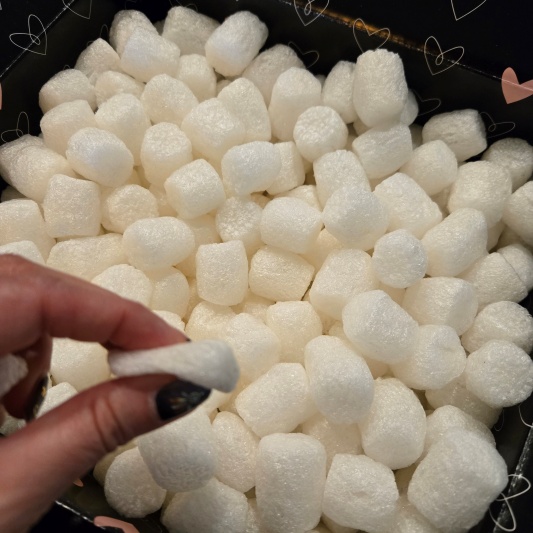
Packing Peanuts
Q. Are these the wrong kind of packing peanuts?A. Yes, those look like the biodegradable kind. If you drop one in a glass of water, it'll pretty much dissolve. You can drop that off at a UPS store, they'll reuse them gladly. If you use them at the bottom of the pot, they will collapse and not provide the air reservoir you want when repotting your orchid. (Jan-25)
)
)
)
Flower Blasting and Burned Edges
Q. This cattleya produced a couple wonky blooms and I was thinking of tossing it. Then it produced some nice blooms. Now I’ve got this! What do you think?A. It could be bacterial blighting from moisture condensing on the flowers, but I think it's more likely to be a thrips problem. In the first pic, it looks like thrips attacked the blossom before it opened. In the pic of the open white flower, you can see one of those devils crawling on the lip, and there's never just one. The browning burned edges of the petals and sepals is another sign of thrips. I'd say you are going to have to go to war. Some people use a pump up sprayer to spray all the buds and flowers with something like Orthene twice a week, every week. In my growing area, a bimonthly drench with Orthene so the Orthene is absorbed up through the roots kills the thrips from the inside out. I've been doing that for several years and it has overcome a very nasty thrips problem I was having. (Jan-25)
)
Habenaria Sprouts Early
Q. First time Habaneria grower here. When the leaves turned brown, I gently tugged and they fell off. I then saw this tuber in the soil (photo attached). I was surprised to see it already had green growth. What do I do now? Do I place it in plastic bag and winterize it until Spring or do I pot it?A. Pot it up, it looks like it doesn't want to wait til spring! (Jan-25)