Orchid Culture - 2026 Questions & Answers

by Sue Bottom, from the St. Augustine Orchid Society Newsletter. Email us with any orchid question, if we can't answer it we'll find someone who can! Send photographs too!
)
)
Epi. Stem Broke in the Wind
Q. I’ve had a hard time getting this epidendrum to grow, much less bloom, and now the rain seems to have knocked this part of the plant off. Will it grow with its two little roots, or should I toss it? Should I repot it in something else, maybe Sphag?A. By all means root the Epi, it'll just keep rooting from the stem as it grows up. I probably wouldn't use sphagnum moss, a coarse mix that can handle the rain might be better. You might consider putting it in a basket so you can tie the stems up around the wire hangers. (Sep-26)
)
)
Habenaria Stem Mushy
Q. One of the two new growths on my habenaria are all mushy at the stem. I guess I watered it too much. Any remedy?A. You can only hope it will sprout from a blind eye, but the question is how deep has the rot gotten, has it entered the tuber? So you'll have to fish out the tuberoid and feel it for softness. Any soft spots have to be excised with a single edged razor blade. Then let it dry out on newspaper for a couple days, and dust it with Banrot before repotting it. Withhold water until you see the new rosette, and then be careful to not get water in the rosette. Ellen reported back that there was nothing mushy on the tuber itself, so she is just letting it dry out and will repot it. (Sep-26)
)
What's on this Root?
Q. I was cleaning up this Catt when I saw this. Is it okay or evil?A. They are lacewing eggs that are actually beneficial. Lacewings can eat aphids, thrips, etc. so they're a good thing. (Sep-26)
)
Yellowing and Blackening Leaves
Q. I recently repotted this Schombocatonia Jamaica Fire and suddenly this happened. I feel like the whole plant is infected. No leaves are immune to the spots. The leaves are firm, not mushy. What should I do? I have Banrot that I can use.A. It's probably bacterial, possibly black rot. I think you're going to have to resort to radical surgery. Pull it out of the pot and cut away all the older damaged tissue. When you've got it all cleaned up, lay it out on newspaper dry and get a soft paint brush and dust the plant with Banrot. After 2 or 3 days of dryness, you can repot it, or it would do well on a mount. Good luck! (Aug-26)
)
Rot from Water Pocketing
Q. I hate when the heavy rain gets into new leads in this heat. The bacteria go like gang busters and I had to cut three leads today. To combat this I have to split the sheath that wraps the terminal leaf(s) so that the water drains out of the sheath. I only can do that after the leaves have started to flatten. Have you ever treated new sheaths with dilute antibiotic to set back bacteria?A. I've heard of pouring a little hydrogen peroxide in the crown of phals after watering to prevent crown rot, you could try that to prevent bacteria from destroying the new lead. Antibiotics like streptomycin and oxytetracycline are used for bacterial blighting in pome fruit trees, shrubs and some ornamentals. (Aug-26)
)
Blackening on Cattleyas
Q. The leaves and pseudobulbs on these cattleyas are soft and squishy, and it is spreading fast. What do I do?A. You will have to cut away all the damaged tissue, and then spray what's left of the plant with copper. Excessive leaf wetness is an invitation for bacterial and fungal infections. (Aug-26)
 "Not Many Flowers")
Not Many Flowers
Q. I have a healthy, good-sized C. Tropical Pointer 'Cheetah' that has beautiful flowers, but it is a poor bloomer, i.e. few flowers for its size. This year, it managed only two. Are spotted orchids are often like this? It does have C. aclandiae in its ancestry, a well-known curmudgeon. More light? Raise it up, or will it always be stingy?A. I don't think the spotted orchids as a whole are reluctant bloomers. In fact, Ron Midgett from New Mexico got a cultural award on Tropical Pointer 'Cheetah' with 55 flowers. Cattleya aclandiae can tend to lower flower count, but it is pretty far back in the family tree. One of Tropical Pointer's parents is intermedia which can throw off tons of flowers. I'd say move it up into brighter light and see if you don't get rewarded next year. (Jul-26)
Heat Damage or Something Else
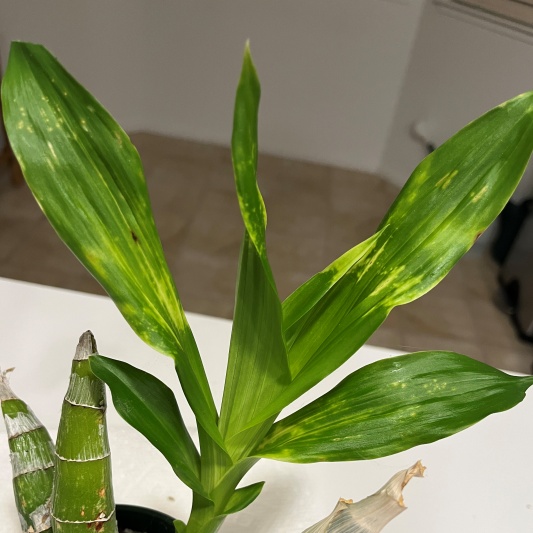
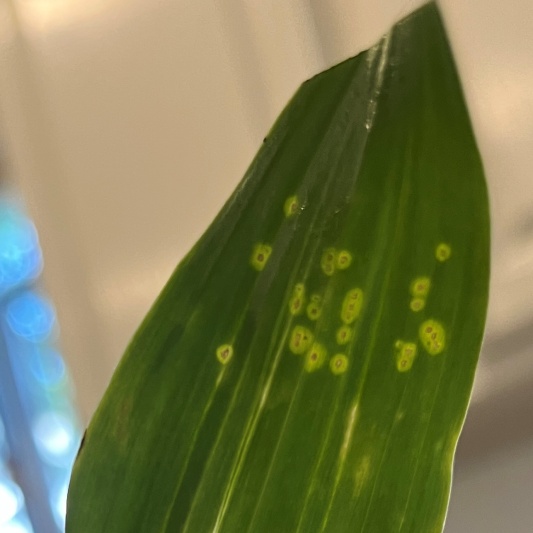
Q. I hang all my Catasetinae in nearly the highest point in my greenhouse. Is it possible this marking is due to sunburn or heat? The catasetum tested negative for virus. There are a few others just leafing out which look similar but at least two that look normal with no leaf streaking.A. The heat scorch makes sense, the leaf temperature got so high that it damaged the chlorophyll just short of burning the leaf. Keeping a max min thermometer handy in strategic locations will tell you how hot or cold your growing area has gotten. Heat scorch explains the chlorotic streaking on the leaves, but there is also fine dotting on the leaves toward the tips, so I asked Janet to send a pic of the leaf underside. When catasetum leaves are young and tender, they are thrips magnets and you can see the bulls eye pattern on the leaf undersides from thrips feeding on the leaf. I do a bimonthly drench with Orthene (1 tsp/gal, same as for spraying) and thankfully I haven't seen thrips damage for several years. It also keeps the scale and mealys gone. (Jul-26)
 "Repotted Dendrobium Leaf Yellowing")
Repotted Dendrobium Leaf Yellowing
Q. I repotted this orchid last month into lava rock and charcoal. It had been in a mixed mix. It’s two pieces, one is totally turning yellow leaf by leaf and the other one has new growth at the bottom. I guess one doesn’t like the new mix?A. It looks like the growth to the left in the picture is dying, so I would remove it from the pot. The one to the right in the picture should have had the oldest part of the plant flush against the edge of the pot so it would have more room to expand in the future. If the potting mix was radically different, the old roots may not acclimate. If there is new root growth, leave the plant alone to recover. If there isn't, remove the one piece and resituate the other, and consider whether the pot size is right. You'll want about 3-4 years in the pot, and the canes grow pretty closely together. (Jul-26)
)
First Orchid - What's Next?
Q. This my first orchid. The flowers lasted a good while but finally dropped off. I don't know if I should cut the old flower stem back. I also don't know if these new growths are flower stems or roots that are growing vertical. If roots, then why are they growing toward the ceiling? Also, should I rotate the plant so the leaves don't all continue in one direction towards the sunny window? As you can see, I don't know much. Any advice will be appreciated.A. There are different schools of thought on cutting back the flower stem, some like to trim it back and hope for a few more flowers. I prefer to cut the stem back entirely and let the plant gather its strength for a great blooming next spring, rather than waste its energy on a few buds. The new growths are aerial roots, sometimes the phalaenopsis just likes to grow aerial roots and sometimes it suggests the potting media may becoming stale and need to be refreshed. Gently pick up the plant by the leaves and see if the plant is wobbly in the pot, if so it is time to repot it into fresh mix. Rotating the plant is a good idea is you have to grow indoors during the warm months, even better would be to find a somewhat shady spot outdoors protected from rain and let it summer in the fresh air, returning it indoors when outside temps dip below 60. Once the plant is in spike, you'll have to stop rotating it because the flowers will become twisted as they try to grow toward the light. We have assembled lots of tips for beginners. (Jun-26)
)
)
Splotchy Spotting on Cattleya Leaves
Q. This Catt has these two infected leaves. Is it Cercospora? Should I cut off the two leaves? I sprayed a couple days ago with 3337F.A. That sure looks like one of the Cercosporoid fungi. I would remove the leaves to remove the sporing bodies from your growing area. The thiophanate methyl you sprayed should help protect the remaining leaves. (Jun-26)
)
What's Chewing on My Orchids
Q. Does this look like rat damage? I did find rat poop in a pot where the bulbos were being chewed. There are fast food restaurants not far. What would I do if it's rats?A. Definitely could be rat damage. There are plastic box traps you can buy to put the rat poison in to keep pets away from it. There are also some poisons that have a low risk of secondary poisoning. Here's a link to an article about Orchids and Rats. We've had rat problems before and no fast food restaurants close by. Tthey ate the wiring in my carand it cost $6000 to rewire it. (Jun-26)
)
Brown Leaf Tips
Q. I have been fighting this disease on my huge Green Hornet for years. I’ve sprayed with many things, to no avail. Possibly I didn’t follow up with a second spraying?A. That looks like anthracnose on the Epidendrum/Prosthecea. Those fine dots on the brown leaf tips are the sporing bodies that spread the disease. Cut away the damaged leaf tips. You might consider spraying monthly with something containing thiophanate methyl until you don't see the disease anymore. More air movement and less leaf wetness also help prevent fungal infections. (May-26)
)
)
Time to Repot
Q. Is this the right time to divide and/or repot this Cattleya?A. Yes, repot/divide it now. You can cut the new growths off and repot it into a new pot, probably the newest five pseudobulbs can be removed,but be gentle with those new roots. Then decide what you want to do with the older part of the plant. If the old mix is still okay, you may wait for a new growth to sprout from the back bulbs, but it looks like it's trying to escape from the pot so the mix may be degraded or have become salty. (May-26)
)
)
Black Spotting on Bifoliate
Q. This bifoliate has had black spotting since it was fairly young. It sort of looks like a sooty mold that doesn’t wipe off. Treating it with mild fungicide had no effect, but since the plant was otherwise OK and flowered nicely (no color break), I've kept it. Now, however, although the last two sets of leaves are clear, diffuse spotting is on all the other leaves. I can't ignore whatever is wrong with it. Should I invest in a virus test, treat it, or just toss it?A. I love the bifoliates, but sure hate to see that black splotchiness. It is suggestive of Cymbidium Mosaic Virus although the diffuse spotting is also suggestive of a fungal infection, particularly with the fine dotting on the leaf undersides. There is really only one way to rule out virus and that is to test it. So if you test it and it's positive, you probably toss it. If you test it and it's negative, you have a fungal problem to deal with, which would require you to cut away a clean section of the plant, treat it with a systemic fungicide and then get it growing again. (May-26)
)
Browning Pseudobulb on Cattleya
Q. I noticed this ugly growth in the very middle of my Blc. Goldenzelle. Fortunately, it was on a separate section and I could cut it out nicely. What is it?A. I'd guess that is damage caused by Rhizoctonia solani, often called brown rot. In cattleyas, Rhizoctonia moves slowly from the older to the younger pseudobulbs and moves up the pseudobulb, which turns brown and hard, ultimately becoming husky. The roots on the older, infected parts of the plant die. You've cut away the infected tissue. You may consider repotting the front healthy part of the plant into fresh mix in the spring when you start to see new roots. (Apr-26)
)
Yellow Spots on Cattleya Leaves
Q. I have yellow spots on the leaves and at the base of most of the leaves of a Blc. George King "Southern Cross." Likely the yellowing was caused by scale that has since been removed, and the plant treated. There are no obvious signs of scale at this time. Sometimes I see yellowing at the base of leaves on other orchids, when I don't see any scale. I usually swab some isopropyl alcohol around as a precaution. Is it something else? Will these plants ever regain color?A. The affected leaves won't regain their full green color because the scale destroys the chloroplast when they suck the juices from the plant. You'll just have to wait for the new growths to get nice green leaves. Whenever you see chlorotic spotting on the upper surface of the leaf, it is a good practice to look at the leaf underside for signs of scale, that also love to hide in the leaf axil and under the papery sheath surrounding the pseudobulb. (Apr-26)
)
)
Yellow Leaf Tips on Phalaenopsis
Q. Any thoughts on the cause and treatment for the yellowing tip ends of our Moth orchid. Could it be Anthracnose or just poor conditions and watering style. The orchid lives in a large double glazed window, west facing. Plenty of light, shaded by blinds with sometimes but not often bright sun.A. That phal looks very happy and healthy. The one leaf looks almost like it might have gotten sunburned or too cold next to the window. I don't think it's a disease issue. I would probably just take a single edged razor blade and cut off the discolored tissue, then you won't have to look at it any longer. It looks like you're going to get plenty of flowers soon, enjoy them! (Apr-26)
)
)
New Cattleya Growth Deformed
Q. My Blc. Lily Marie Almas has 4 new growths, 2 of them are deformed and the flowers have black on the tips. It tested negative for virus. It's growing in a sphagnum/styrofoam combo (it's how I bought it a couple years ago, I usually grow in bark), and generally, I never let it go completely dry, just when the moss is just about totally dry will I water again. I pulled the plant out of the pot and was surprised at how much styrofoam was in there. The new growths make me think of dehydration. Google told me the black on the flowers could be fungus. I'm really stumped.A. I agree with your thoughts on the new growths, it looks like they didn't get enough moisture when all those new growths were forming. The styrofoam/sphagnum moss combo isn't bad for cattleyas, but it is different from your normal mix so you would water it differently from those in bark. I tend to have all my similar type plants in a similar potting mix so when I water one, I can water them all. In the spring or whenever you see the beginning nubs of new roots, pot it up in your normal mix, I'm guessing it will recover well. The flower looks like bacterial blighting to me, which is the opposite problem from dehydration. If you've had it under lights during the winter, perhaps the flowers got burnt. (Mar-26)
)
)
Cattleya Backbulbs Yellowing
Q. This cattleya’s leaves are turning yellow from the top down. Several months ago, two other leaves did this and the pseudobulbs turned mushy and almost black. I cut them off at the rhizome and treated with Subdue Max and thought I fixed it but here I am again. This plant has been in the house since the cold weather started so I don’t think it’s related to the weather. Any advice you can give will be greatly appreciated!A. I think I would repeat your earlier treatment, cut off the yellowing bulbs at the rhizome and treat with Subdue. Once you see the new root nubs beginning to form in the spring, you can think about repotting the youngest section of the plant into fresh mix. Looks like you're getting a beautiful flower on it. (Mar-26)
)
)
When to Repot Bifoliate
Q. I would like to repot this Cattleya but I’m not sure about the timing. It’s a bifoliate and it’s in bloom. But the medium has broken down and the back bulbs look very dehydrated and lackluster. Could you give me advice?A. The best time to repot is right before the plant sends out new roots. However, if the mix is starting to degrade, perhaps you could turn the pot upside down and jet away what you can with a hose end sprayer. If the plant falls out of the pot, then you can pot it up as you normally would, but if it is still stable in the pot, either drop a few pieces of bark back in or leave it with the void space until you see new roots. (Mar-26)
)
Cattleya Growing Out of Pot
Q. What would you do with this Lc. Carlad's Mini-Quinee 'Angel Kiss'? The roots have grown way out of the pot. Now it has growth coming out of both sides into the air. New roots and new growth are starting now. Shoule I shove it into a bigger pot and let the roots bunch up, cut it in half and put it into two larger pots, or just let it fly in the air and let it figure it out?A. It looks like a wild child, that will never be happy in a pot. Maybe it would be happier in a basket, cut away the plastic pot and drop it into the basket as is and let it go hog wild. Or maybe get a long vertical mount and cut it into 2 pieces, mount them on opposite sites at the bottom and let it climb to its heart's content. (Feb-26)
)
)
Color Break in Cattleya
Q. Does this C. percivaliana 'Summit' look like it has virus induced color break? The plant is vigorous and without any leaf issues.A. That sure looks like color break, pretty severe. I find that color break is sometimes more obvious when looking at the back of the flower. As to the leaves, sometimes virused plants have leaf markings, such as chlorotic or necrotic streaks or red V shaped lesions, though sometimes the leaves are clean. Sometimes growth vigor is poor with virused plants, and sometimes it is excellent. In any case, that is a real shame, because that is an otherwise beautiful orchid. (Feb-26)
)
Summer Blooming Phal Spike Yellowing
Q. My specialty phals have been in the garage with grow lights. I’ve not been watering as much as usual (twice/to three times a week) and given them no fertilizer. I’ve not seen a spike turn this color before.A. That spike is getting ready for the final goodbye. You can just wait for it to turn brown or cut it off. We've had more cold nights this season than I remember in the last couple of years, and that may have hastened its demise. (Feb-26)
Bruise-like Spots on Cattleya Leaf
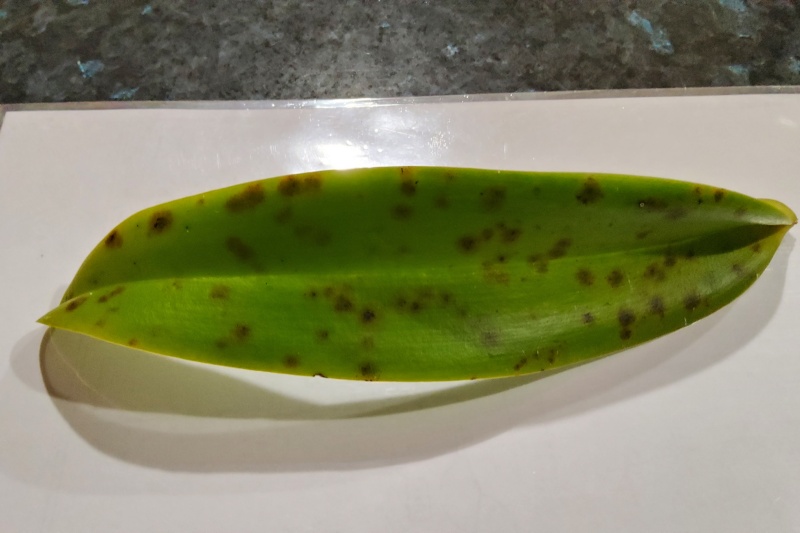
Q. I have looked at a lot of photos of leaf problems but cannot find one that resembles the problem I am having. These bruise like spots are only on the topside of the leaf, the underside is perfect. Are you able to identify the problem?A. My guess would be that is one of the leaf spotting fungi, possible one of the cercosporoid fungi. You have already removed the severely damaged leaf, the question is whether any spores have spread the problem. You could protect the rest of the plant by spraying with one of the chemicals effective on leaf spotting fungi, such as thiophanate methyl (trade names include Banrot, Thiomyl, T Methyl, 3336F). (Jan-26)
)
)
Flowers Don't Bloom from Sheath
Q. I have a persistent issue with some flowers not coming to maturity. It's always and only in plants where the flower has a sheath around it. They form and once in a blue moon flower, but usually dry up and do nothing. Anything that gets a sheath tends to not bloom. I don't think it's fungal, spraying doesn't help. Any thoughts?A. I don't think it's a fungal issue. For the first image where the sheath is yellowing, I think what happens is moisture condenses in the sheath and rots the bud. If the sheath is green or dried, leave it on the plant, but if it gets that sickly tan to brown color, gently slit the sheath and peel it down so water won't condense in there and cause rot. I think happens mostly in the fall and spring when there is a large difference in the day night temperature. In the second picture with the dried sheath, it is possible it is natural, some cattleyas form the sheath and then rest for several sometimes many months before flowering, like a skinneri. It is also possible the plant is not mature enough or not getting enough light to form sufficient energy reserves to bloom. (Jan-26)
)
Repot Mormodia?
Q. Is it time to repot this Mormodia or should I let it bloom out?A. I'm betting those are flower spikes. This is the bloom season for mormodias. You probably won't see the new growths peeking out til February or March. That's when you can think about repotting. (Jan-26)